
By Behnood Neshat · Published
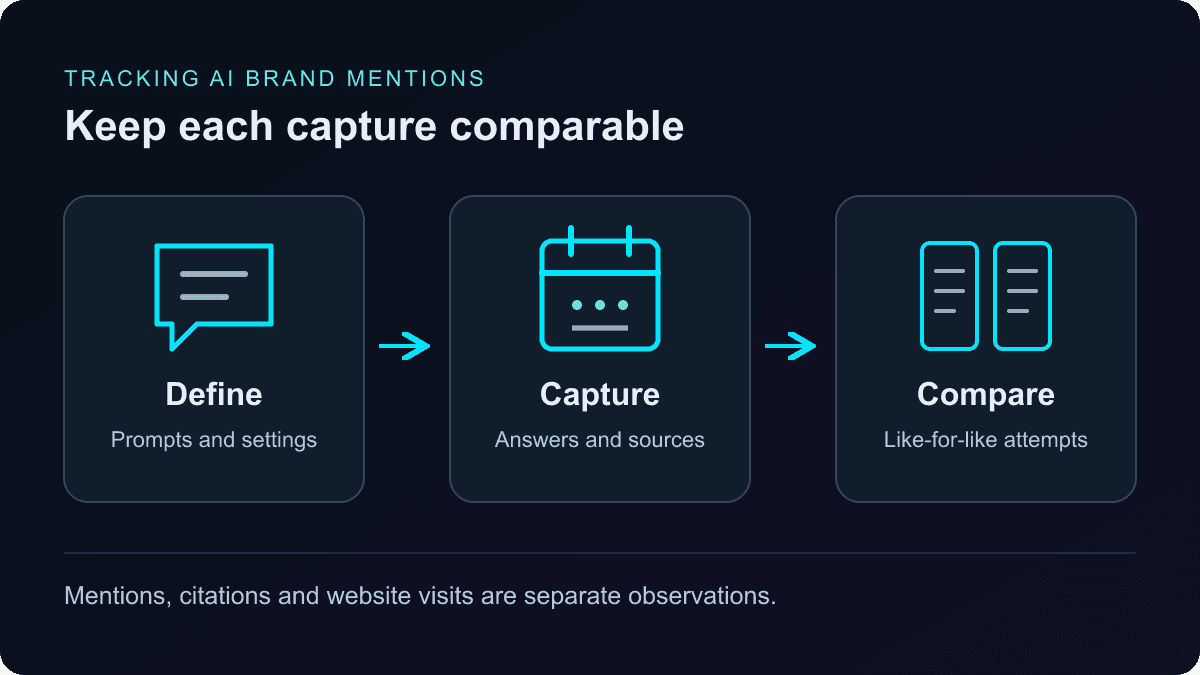
To track brand mentions in AI search, repeat a defined set of buyer questions, save the answers with their dates and settings, and check whether each answer identifies your business. Keep mentions, citations and website visits separate. The result is a record of sampled answers, not a universal ranking or a count of everyone who saw your brand.
This method works as a manual spreadsheet before you choose a monitoring tool. Use it to decide what evidence to collect and whether a change deserves investigation.
1. Define what counts as a brand mention
- Mention: the answer names the correct business. Check ambiguous names against its location, domain or services.
- Citation: the answer links to a source. Record whether that source is your website or somebody else’s; a linked page can appear without a brand recommendation.
- Referral: a measured visit to your website. It requires separate analytics evidence; an answer or citation alone does not establish a visit.
Save the surrounding sentence. A warning about a business and a recommendation are both mentions, but they require different responses. Use manual review for ambiguous matches instead of treating every name match as success.
2. Choose buyer questions, then freeze the wording
Start with questions drawn from real sales conversations and customer research. Group them by discovery, comparison and branded research. Keep branded questions in their own group: asking about your business by name does not test whether an assistant would introduce it unprompted.
An illustrative discovery question is “Which bookkeeping services support small construction firms in Irvine?” A comparison question might ask what to check when choosing that service. Write only locations and needs relevant to your actual customers.
Give each question an ID and keep its wording unchanged between checks. Set the schedule and number of repeats before running them; save every result. When you add a market or rewrite a question, start a new version instead of silently changing the baseline.
3. Keep consumer tools and API tests separate
Record exactly where the answer came from: the consumer product or an API, visible model, search setting, language and location. Start a fresh conversation for each scheduled question and document memory or personalization settings. OpenAI explains that ChatGPT search can use location and saved memories when forming searches.
An API-based monitoring run is not a recording of a customer’s ChatGPT session. OpenAI’s web-search API documentation describes configurable search tools and returned citation annotations. These controls and the consumer product’s context are reasons to report the two samples separately, rather than assume equivalent answers.
Keep Google AI Overviews and AI Mode separate too. Google says their models, responses and supporting links can differ, and an AI Overview may not appear. Record “feature not shown” instead of calling that a failed brand mention.
4. Capture evidence in a dated worksheet
Method version: October 23, 2026. Copy these fields into a spreadsheet; use one row per attempt. Store full answers privately where your team can review them. Do not publish customer information or private conversation context as evidence.
| Field | What to record |
|---|---|
| Capture | Date, time, time zone, reviewer and a saved answer or screenshot. |
| Question | Prompt ID, exact wording, intent group and prompt-set version. |
| Environment | Product or API, visible model, language, location, search mode and personalization settings. |
| Attempt | Answer returned, error, refusal or feature not shown; keep every scheduled attempt. |
| Brand | Correct business identified? Mention present? Recommendation, neutral reference or criticism? |
| Evidence | Exact mention excerpt, citation URLs, cited domain and any factual error. |
| Follow-up | Comparable previous capture, change to investigate, owner and next check date. |
Open cited pages and verify the business identity and supporting statement. A source listed as consulted is not necessarily a citation in the final answer; keep those fields separate when a tool supplies both.
5. Compare counts with their denominators
For each product and prompt group, report answers naming your brand alongside valid answers received. Report failed attempts separately. If no valid answer returned, mark the mention rate unavailable. For Google Search, also report how often the AI feature appeared within successful search captures.
Compare only questions and environments available in both periods. Flag model changes, changed settings and missing runs before interpreting movement. Keep repeated answers as separate observations; do not retain only the most favorable one. A small sample is a diagnostic, not an estimate of total market exposure.
Review website outcomes alongside this log. Google includes AI-feature traffic in Search Console’s overall Web performance reporting; that total is not your worksheet’s mention count. If available for your property, Google’s Generative AI performance report adds AI-feature link impressions by page, country, device and date, without a query dimension; it does not count every unlinked brand mention. Track inquiries separately from visits, and avoid attributing every change to AI visibility.
6. Choose the next action from the evidence
If an answer uses an outdated address, inspect its cited source and correct information you control. If competitors appear for a service you genuinely offer, inspect the question and cited pages for missing factual details. Absence alone does not prove that crawling, schema or a particular sentence caused the omission.
Log the page changed, the reason and the date, then repeat the original questions. A later mention is an observation; establishing that your edit caused it requires stronger evidence than a before-and-after screenshot.
For a first check of your public website, use the free AI visibility checker. For recurring collection, see our AI visibility tracking service and its measurement limits. Bring your prompt set and worksheet when you discuss a monitoring plan.